
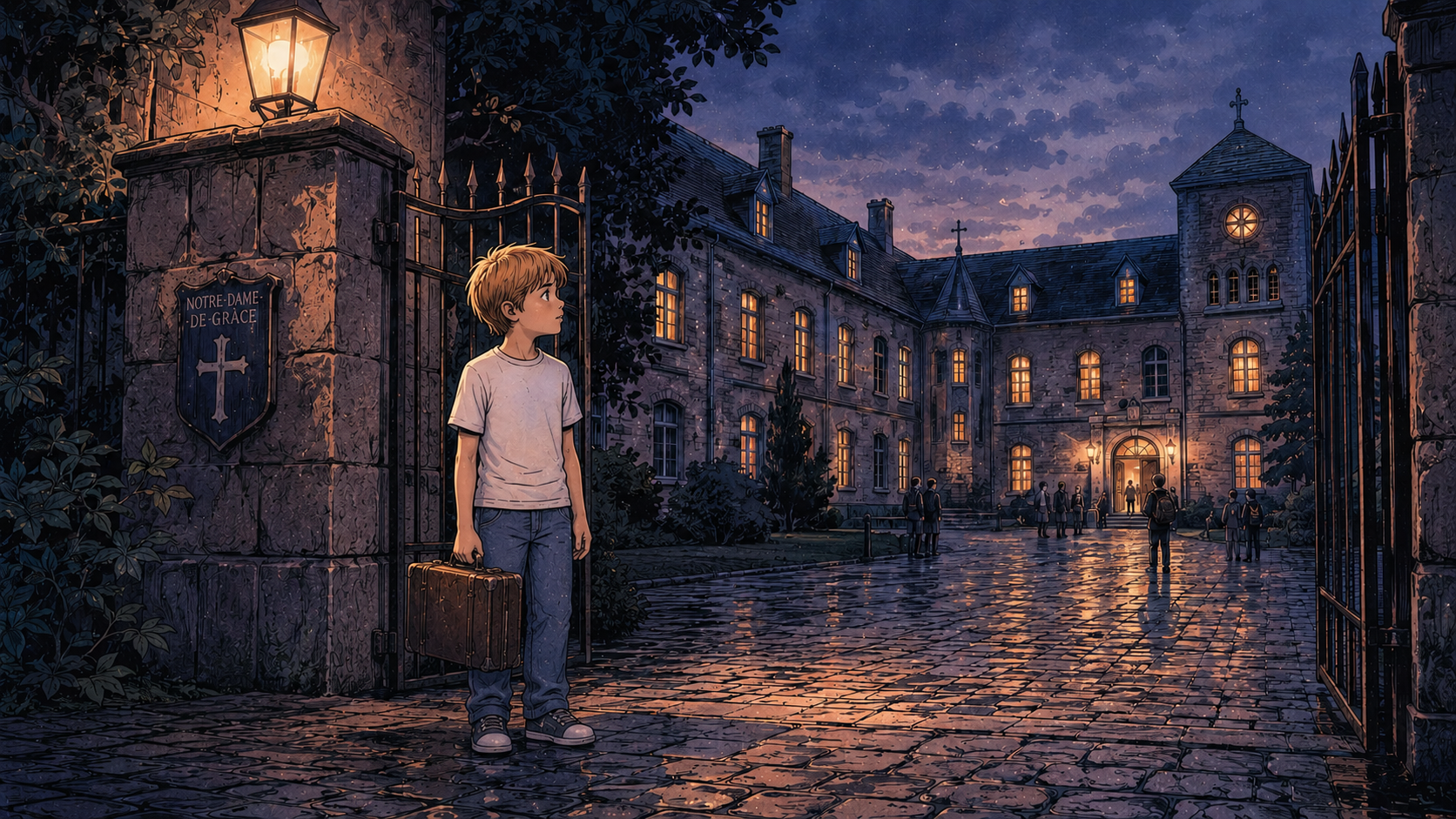
- Notre-Dame-de-Grâce marks the narrator’s physical separation from his brother.
- Bullying is portrayed as repeated, physical and psychological.
- The narrative focuses on adults who fail to protect the child.
- The episode forms part of Artagan’s Nous étions deux.
Artagan’s Journal · Nous étions deux
At Notre-Dame-de-Grâce, the narrator of Nous étions deux enters boarding school alone in his first year of secondary education, where persecution, humiliation and violence become daily events. Above all, the narrative questions the silence of adults who knew, yet failed to protect a child aged twelve or thirteen.
Why is Notre-Dame-de-Grâce central to Nous étions deux?
This period marks the passage from a childhood lived as two to an ordeal faced alone. Until then, brotherhood had remained a fragile refuge. At boarding school, this protective bond physically disappears. The change also gives another meaning to the title Nous étions deux: the brother’s absence is not merely a separation, but alters the way the child faces what happens to him.
In Artagan’s narrative, this solitude helps explain why certain memories remain so precise. When no close companion is there to share the ordeal, each place, each silence and each adult reaction acquires particular importance.
How is the bullying described?
Bullying is not presented as a succession of isolated incidents. Humiliations are repeated, physical violence joins psychological violence, and the victim understands that speaking out is not enough to make adults intervene.
This repetition matters because it turns occasional fear into constant expectation. The child no longer worries only about what might happen; he begins to anticipate the places, moments and people associated with the violence. A boarding school that should provide education and daily structure instead becomes a place requiring permanent vigilance.
When an adult sees and does nothing, a child may experience that silence as permission for the violence to continue.
Why does adult inaction worsen the violence?
Adults represent the authority capable of setting a boundary. Their inaction removes that boundary. The child must not only avoid his attackers; he must also understand why those whose role is to protect him look away.
This second abandonment is one of the elements the narrative seeks to make visible. Asking for help still requires a child to believe that an adult can intervene. When that attempt produces no protection, trust is weakened and isolation deepens. Silence therefore becomes part of the experience itself, alongside the acts of bullying.
What does it mean to be alone at twelve or thirteen in boarding school?
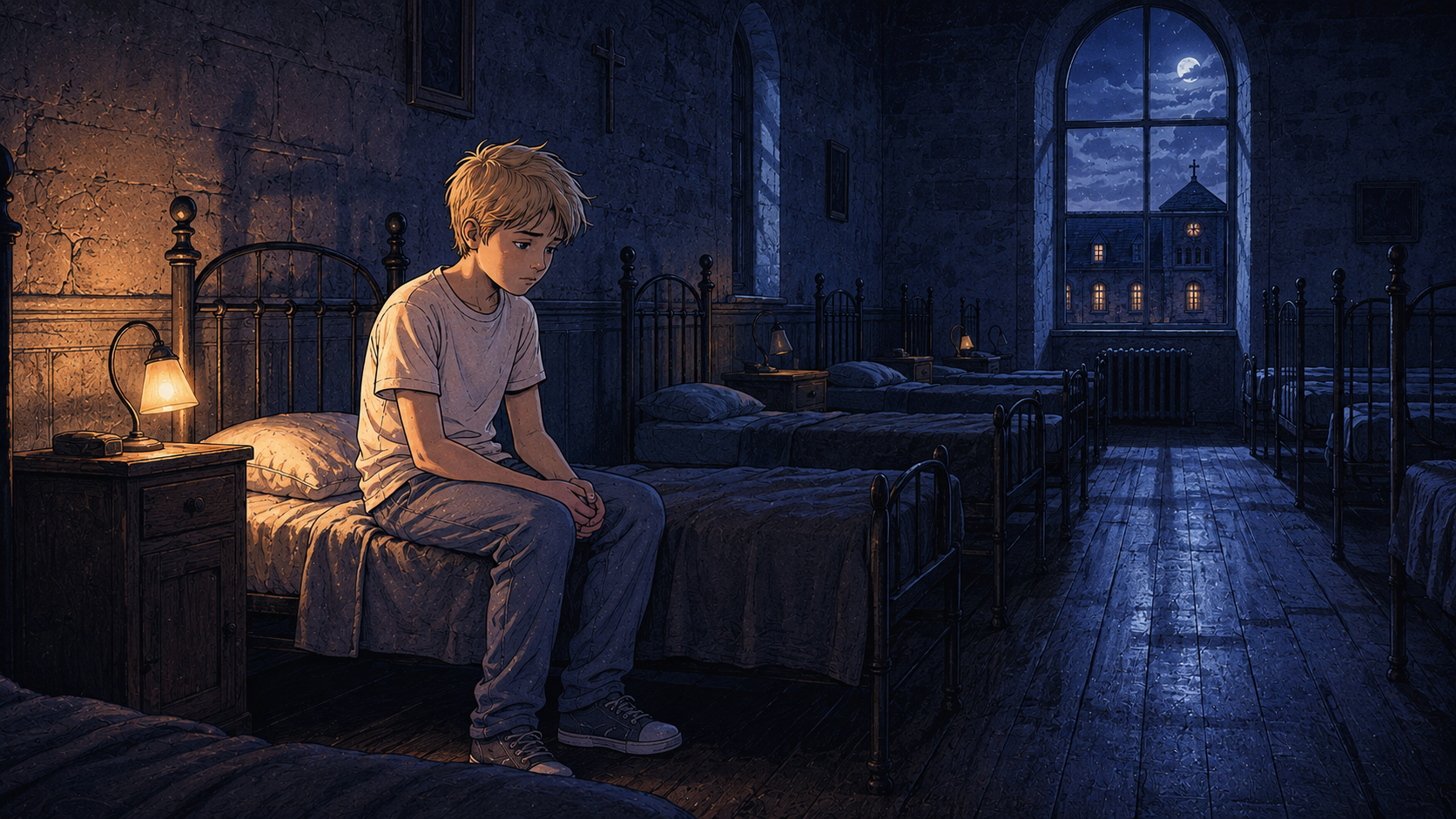
Boarding school occupies almost all of daily life: lessons, the playground, meals and the dormitory. There is no real way out when violence takes hold in each of these places. Evening does not close the day; it extends the confinement.
At that age, being separated from a brother also means losing the person with whom earlier experiences had been shared. That absence explains why brotherhood remains central to this chapter even when the brother is not physically present.
Why does Artagan tell this story?
Writing makes visible what had been kept silent. Artagan restores the experience to a child’s viewpoint, with his age, solitude and concrete attempts to obtain help. The narrative refuses to let the story disappear because it is disturbing.
This approach also connects with Artagan’s explanation of why he writes: memories and difficult experiences can be transformed into a story and passed on to others. In Nous étions deux, family memory and brotherhood provide a wider frame, so the book is not reduced to a single ordeal.
Frequently asked questions
How old is the narrator?
He is in his first year of secondary school and is about twelve or thirteen.
Is his brother with him?
No. He faces boarding school without his brother.
Why is the adults’ silence important in the narrative?
Because the child expects the institution and its adults to set a boundary. Their failure to react deepens his sense that he is alone in facing the violence.
Where can the story be found?
In Artagan’s Nous étions deux.
Lire cet article en français · Written by Artagan · Updated 1 September 2026 · Personal testimony and narrative