
- The article recounts a family experience from Nous étions deux.
- A spousal gift is not presented as inherently abusive.
- Family heritage is portrayed as memory as well as financial value.
- The article does not provide legal advice.
Artagan’s Journal · Heritage and family line
In Nous étions deux, the spousal gift becomes, in the experience described, the instrument of family dispossession. The two brothers see assets built over several generations benefit their stepmother and experience the decision as exclusion from their own family line.
Clarification: a spousal gift is a legal arrangement that is not inherently a weapon or an abuse. This article examines only its use as experienced in the narrative. It is not legal advice.
Why does it become a weapon in the narrative?
It becomes a weapon when its perceived purpose is no longer merely to protect the surviving spouse, but to exclude the children from a family legacy built before them. The assets represent the work of ancestors, grandparents and a great-uncle.
In the book, this feeling comes less from the legal mechanism itself than from what it means to the two brothers: the sense that family continuity stops in front of them. What they had understood as the legacy of several generations suddenly seems to change direction.
What does the family heritage represent?
In Nous étions deux, heritage is memory made tangible. It bears the trace of the work and sacrifices of several generations. Being deprived of it therefore means losing more than an asset: the children feel deprived of their place in the family line.
This dimension gives the episode much of its force in the narrative. A house, land or another asset is not described only in financial terms: it becomes a concrete trace of family history. The sense of dispossession therefore concerns memory as much as money.
One may be excluded from property; sometimes the greatest violence is being excluded from the history that property represented.
How do the brothers learn of their dispossession?
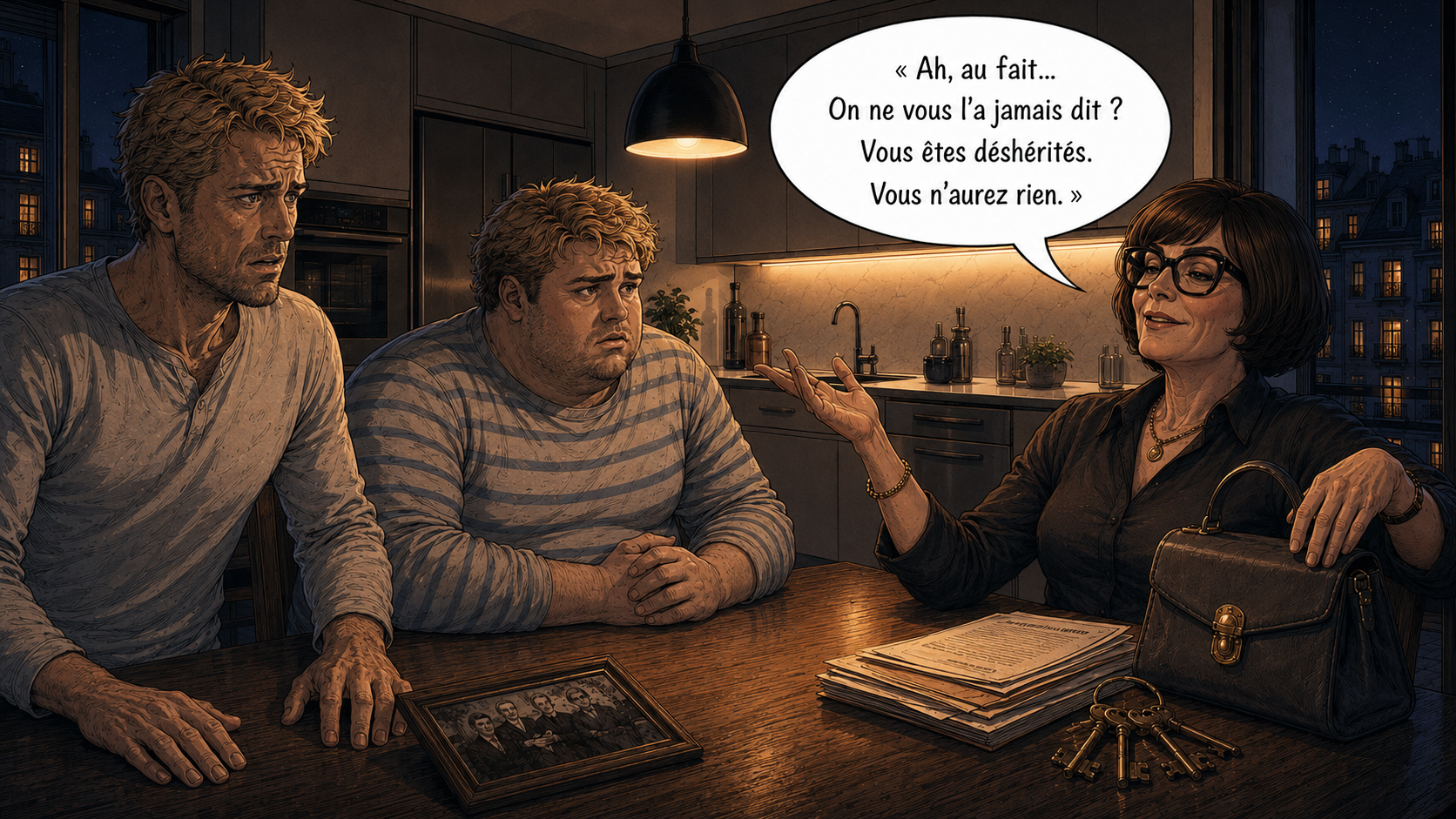
The announcement takes place in a kitchen. The setting is ordinary, but the words are final: the assets will benefit their stepmother. This contrast feeds the narrative’s dark humour and the sense of witnessing a “family robbery” without a forced safe or a mask.
The everyday setting matters in the way the episode is told. There is no ceremony and no dramatic staging, only a family conversation whose consequences are considerable. That contrast is precisely what gives the scene its almost unreal quality.
Why is the notary’s call a final absurdity?
After learning that they will not benefit from the assets, the brothers receive a call telling them they will also have to bear the cost of works. Family membership disappears when it is time to pass something on, then returns when it is time to pay.
In the narrative, this contradiction takes on an almost satirical dimension. It does not change the legal reality of the situation; it simply shows how the two brothers experience it, with the feeling that obligations may remain even when the benefits of transmission have disappeared.
What place is left for the son with a disability?
The inheritance could have provided protection or security. Instead, in the story told, it becomes an additional source of vulnerability and exclusion.
His situation reinforces the human dimension of the episode: the question is no longer only how assets are divided, but also what each member of the family might have expected from that transmission and from the security it could have represented.
Why turn the story into a work of literature?
Literature makes it possible to distinguish the legality of a mechanism from the violence of how its use is experienced. Writing means reclaiming the story: assets may be passed elsewhere, but memory and speech can no longer be confiscated.
This approach echoes what Artagan explains in Why I write: turning an ordeal, an injustice or a memory into a story. Nous étions deux does not try to replace law with literature; it tells what a family decision can leave behind in those who experience it.
Frequently asked questions
Is a spousal gift always unfavourable to children?
No. This article deals only with the case told in Nous étions deux.
Why speak of dispossession?
Because the brothers experience a financial, memorial and symbolic loss.
Does this article give legal advice?
No. It describes a family experience as told in the book and does not attempt to provide a legal qualification of the situation.
Are the people identified?
No. No civil identity is disclosed.
Lire cet article en français · Written by Artagan · Updated 1 September 2026 · Personal narrative and literary analysis