
Artagan’s Journal · Nous étions deux
In Nous étions deux, brotherhood is the first refuge of two children confronted with rejection. When the narrator is separated from his brother at a very young age, he also loses the only person with whom he shared what no adult seemed willing to hear.
Why does the bond between two brothers become a refuge?
When the family no longer protects, a brother’s presence can become the last place where a child does not need to explain everything. The two children understand situations together that they cannot yet name. Their closeness does not remove suffering, but prevents either from being entirely alone before it.
In Nous étions deux, brotherhood is therefore not simply an emotional theme. It is a form of inner survival: proof that another person sees, feels and remembers.
When the family no longer protects, the bond between two brothers can become the last refuge.
What does the brothers’ separation cause?
The separation deprives the narrator of his witness and ally. Still very young, he no longer sees his brother and is left without the person who shared his story. Isolation becomes emotional as well as geographical.
This rupture prepares the Notre-Dame-de-Grâce period. The narrator enters boarding school alone, without his brother or any other refuge. What might have been endured together becomes an ordeal lived in silence.
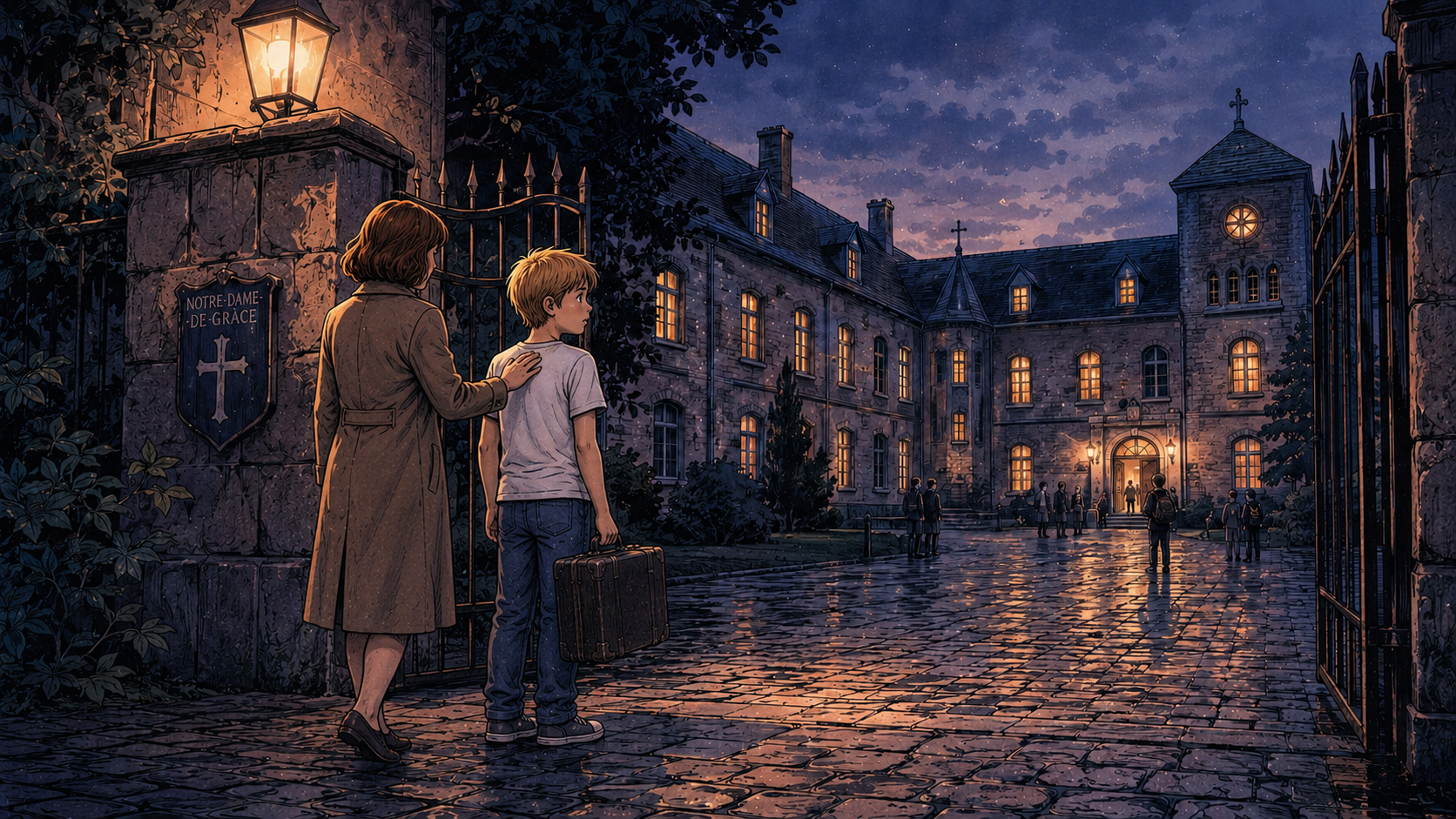
Why does the narrator spend hours avoiding his classmates?
At boarding school, avoiding others becomes a strategy of protection. He organises his movements and time so that he is not found, beaten or exposed to the more serious violence described in the book.
This constant flight shows what bullying does to daily life: the child is no longer free within the institution. His energy is first used to anticipate danger, identify places to avoid and reduce encounters.
How does the brother’s absence transform solitude?
Without his brother, the narrator no longer has the person who could confirm that his fear and pain were real. Solitude becomes inner confinement. Even among pupils and adults, he feels seen by no one.
The silence of adults worsens this absence. The child finds neither in the institution nor in his family the protection previously offered by the brotherly bond.
Why does Artagan tell this separation today?
Telling the separation shows that violence does not always begin with the first blow. It may begin when a child loses the only relationship that still enabled him to hold on.
Writing symbolically reunites what had been separated. It restores a shared story to the two children and refuses to let their bond be erased by adults’ decisions.
To continue this reading, discover the memoir about two brothers, brotherhood, separation and family memory.
Frequently asked questions
Why is brotherhood central to Nous étions deux?
Because the bond between the brothers is their first refuge in a childhood marked by rejection and lack of protection.
Was the narrator separated from his brother at a young age?
Yes. The separation deprived him of the only person who directly shared his experience and memory.
How does he try to avoid violence?
He spends long hours avoiding other pupils so that he is not beaten or subjected to more serious violence described in the book.
Where can the full account be found?
In Artagan’s Nous étions deux.
Lire cet article en français · Written by Artagan · Updated 30 August 2026 · Personal testimony